
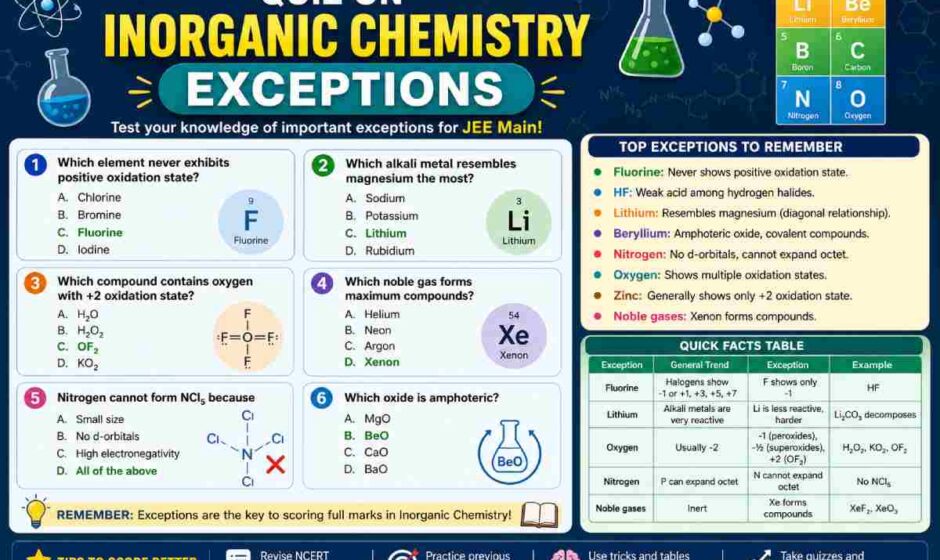

If you’re targeting the upcoming JEE Main exam, by now, you know how tricky Inorganic Chemistry can get. Where Physical Chemistry relies on calculations and formulae, this section emphasizes observation and rote memorization. The surprising truth is that most students score lower not because they don’t know a concept, but because they forget a small – and often unheard-of – exception in NCERT.
The encouraging part is, 80% of JEE Main questions on inorganic chemistry are based directly or indirectly on these scattered pieces of information and exceptions available within NCERT.
Daily practice through a dedicated inorganic chemistry quiz will make you a pro at spotting them easily. We’re here to introduce you to the essential inorganic chemistry exceptions, help you revise them via comparative tables, reinforce your understanding through a quiz, and decode tricky information using innovative memory hacks.
What Are Inorganic Chemistry Exceptions?
Inorganic chemistry exceptions: exceptions to the rule. For exceptions to the rule, refer to an element or a compound that doesn’t follow the rule of trend.
Definition
Inorganic Chemistry: Exceptions – Exceptions are rare or erratic physical and chemical properties of elements and compounds. -These show a deviation from trends that can be established in the periodic table or based on reactivity and type of bond, so in the JEE MAIN they have great importance, especially because there is a very high likelihood that an MCQ shall be based on these concepts.
Why Are Exceptions Important for JEE Main?

Students often focus on concepts but ignore exceptions.
However, JEE examiners love asking questions based on these unusual behaviors.
Some reasons include:
- Direct NCERT-based questions
- High-scoring factual questions
- Easy marks if revised properly
- Frequently repeated concepts
- Helpful for Advanced as well
General Trends vs Important Exceptions
| General Rule | Exception |
| Fluorine shows -1 oxidation state. | Fluorine never shows a positive oxidation state. |
| Nitrogen forms multiple bonds easily. | Phosphorus generally prefers single bonds. |
| Oxygen usually has a -2 oxidation state. | Peroxides (-1), Superoxides (-½), OF₂ (+2) |
| Alkali metals are soft. | Lithium is comparatively hard. |
| Noble gases are inert. | Xenon forms compounds |
| Transition metals have variable oxidation states. | Zinc and cadmium show only +2 |
| Halogens are oxidizing agents. | Fluorine cannot be oxidized. |
Quick Comparison of Frequently Asked Exceptions
| Topic | General Trend | Exception | JEE Importance |
| Fluorine | Similar to halogens | Unique behavior | ★★★★★ |
| Lithium | Alkali metal | Resembles Magnesium | ★★★★★ |
| Diagonal Relationship | Rare | Li-Mg, Be-Al | ★★★★★ |
| Oxygen | -2 oxidation state | Peroxides | ★★★★★ |
| Nitrogen | Stable compounds | No d-orbitals | ★★★★★ |
| Noble Gases | Inert | Xenon compounds | ★★★★☆ |
| Transition Elements | Variable oxidation state | Zn, Cd | ★★★★★ |
| Lanthanides | Similar chemistry | Lanthanide contraction | ★★★★☆ |
Top 50 Inorganic Chemistry Exceptions Every JEE Student Must Know
1. Fluorine is Different from Other Halogens
Fluorine is one of the most frequently tested exceptions.
Reasons:
- Highest electronegativity
- Smallest atomic size
- Highest hydration energy
- No d-orbitals
- Strong oxidizing agent
Important facts:
- Never shows positive oxidation state.
- Cannot expand octet.
- HF is a weak acid.
- Forms hydrogen bonding.
2. Lithium Behaves Like Magnesium
This is called the Diagonal Relationship.
Common properties:
| Lithium | Magnesium |
| Forms nitride | Forms nitride |
| Carbonates decompose | Carbonates decompose |
| Hydroxides less soluble | Hydroxides less soluble |
| Nitrates decompose to oxide. | Same |
3. Beryllium is Unique
Unlike other alkaline earth metals:
- Amphoteric oxide
- Covalent compounds
- High ionization energy
- No flame color
- Polymer formation
4. Nitrogen Has No d-Orbitals
Because nitrogen belongs to Period 2:
- Maximum covalency = 4
- Cannot expand octet
- No pentahalides
Phosphorus forms:
- PCl₅
- PF₅
Nitrogen never forms:
- NCl₅
- NF₅
5. Oxygen Shows Different Oxidation States
| Compound | Oxidation State |
| H₂O | -2 |
| H₂O₂ | -1 |
| KO₂ | -½ |
| OF₂ | +2 |
This is among the favorite JEE questions.
Memory Tricks for Important Exceptions
| Exception | Trick |
| Lithium resembles Magnesium | “Diagonal Friends” |
| HF weak acid | Strong bond = weak acid |
| Fluorine never positive | Most electronegative always negative |
| Nitrogen no d-orbital | Period 2 = No expansion |
| Be amphoteric | Small size = unusual behavior |
Detailed Quiz on Inorganic Chemistry Exceptions
Quiz 1
Q1.
Which element never exhibits a positive oxidation state?
- Chlorine
- Bromine
- Fluorine
- Iodine
Answer: C
Explanation:
Fluorine is the most electronegative element.
Q2.
Which alkali metal resembles magnesium?
- Sodium
- Potassium
- Lithium
- Rubidium
Answer: C
Q3.
Which compound contains oxygen with a +2 oxidation state?
- H₂O
- H₂O₂
- OF₂
- KO₂
Answer: C
Q4.
Which noble gas forms the maximum number of compounds?
- Helium
- Neon
- Argon
- Xenon
Answer: D
Q5.
Nitrogen cannot form NCl₅ because
- Small size
- No d-orbitals
- High electronegativity
- All
Answer: D
Practice Quiz (Intermediate Level)
Question 6
Which oxide is amphoteric?
- MgO
- BeO
- CaO
- BaO
Answer: BeO
Question 7
Which transition metal generally shows only +2 oxidation state?
- Iron
- Copper
- Zinc
- Chromium
Answer: Zinc
Question 8
Which acid is the weakest among hydrogen halides?
- HCl
- HBr
- HI
- HF
Answer: HF
Question 9
Superoxide contains oxygen in an oxidation state of
- -2
- -1
- -½
- +2
Answer: C
Question 10
Which element forms covalent chlorides?
- Sodium
- Potassium
- Beryllium
- Calcium
Answer: C
Advanced JEE Main Quiz
Q11
Which pair exhibits diagonal relationship?
- Na-Ca
- Li-Mg
- K-Ca
- Be-Mg
Answer: B
Q12
Which oxide is a peroxide?
- KO₂
- Na₂O₂
- MgO
- CO₂
Answer: B
Q13
Which element has the highest first ionization energy?
- B
- Be
- C
- Li
Answer: B
Q14
Which halogen has the highest bond dissociation energy with hydrogen?
- HF
- HCl
- HBr
- HI
Answer: A
Q15
Which metal does not impart flame color?
- Sodium
- Potassium
- Calcium
- Beryllium
Answer: D
Most Repeated NCERT Exceptions
| Chapter | Exception | Frequency |
| Periodic Table | Fluorine | Very High |
| Chemical Bonding | Nitrogen | Very High |
| Hydrogen | HF weak acid | High |
| s-Block | Lithium | Very High |
| p-Block | Beryllium | High |
| d-Block | Zinc +2 only | High |
| Coordination | Zn²⁺ colorless | Medium |
| Noble Gases | Xenon compounds | High |
Common Mistakes Students Make
| Mistake | Correct Concept |
| HF is the strongest acid. | HF is the weakest hydrogen halide acid in water. |
| Nitrogen forms NCl₅ | Impossible due to lack of d-orbitals |
| All alkali metals behave similarly. | Lithium is exceptional |
| Noble gases never react. | Xenon reacts under suitable conditions. |
| All metal chlorides are ionic. | BeCl₂ is largely covalent. |
Smart Revision Strategy
| Day | Task |
| Monday | Periodic table exceptions |
| Tuesday | s-Block exceptions |
| Wednesday | p-Block exceptions |
| Thursday | d-Block exceptions |
| Friday | Oxidation state exceptions |
| Saturday | 50 MCQs |
| Sunday | Full revision test |
High-Yield Exception Summary Sheet
| Exception | Key Fact |
| Fluorine | No positive oxidation state |
| HF | Weak acid, hydrogen bonding |
| Lithium | Similar to Mg |
| Beryllium | Amphoteric, covalent |
| Nitrogen | No pentahalides |
| Oxygen | Multiple oxidation states |
| Zinc | Only +2 oxidation state |
| Cadmium | Only +2 oxidation state |
| Xenon | Forms fluorides and oxides |
| BeCl₂ | Covalent |
| Li₂CO₃ | Decomposes on heating |
| Na₂CO₃ | Stable on heating |
Tips to Score Better in JEE Main Inorganic Chemistry
- Read every line of NCERT very carefully, including notes & exceptions.
- Memorize Exceptions Every day instead of mugging them up in one sitting.
- Solve chapter-wise quizzes, topic-wise, by applying NCERT lines.
- Create flash cards of Oxidation States, Uncommon compounds, Periodic trends.
- Do past-year JEE Main papers on exceptions to see what questions are asked again and again.
- Understand The Cause behind Every Exception so it will be Easy To Recall in the examination.
Frequently Asked Questions (FAQs)
Is memorizing exceptions enough for JEE Main Inorganic Chemistry?
No. Memorizing is fine, but grasping the underlying theory and the period trends are key to applying the exceptions appropriately when faced with an unseen problem.
Which chapter has the maximum number of exceptions?
The p-Block Elements chapter contains the highest number of important exceptions, followed by Chemical Bonding, Periodic Table, and the s-Block Elements.
How many inorganic exceptions should I revise before JEE Main?
Aim to revise at least 80–100 high-yield exceptions from the NCERT textbook and your coaching notes. This covers most commonly tested areas.
Are NCERT exceptions enough for JEE Main?
For the majority of direct factual questions, NCERT is the primary source. Supplement it with previous years’ questions and quality mock tests for complete preparation.
What is the best way to remember inorganic chemistry exceptions?
Use a combination of:
- Flashcards
- Comparison tables
- Daily quizzes
- Mnemonics
- Weekly revision sessions
Final Thoughts
The JEE Main Inorganic Chemistry chapter may be feared by aspirants owing to the multitude of exceptions, but with a systematic strategy, it is one of the highest scoring topics in Chemistry. To avoid mugging up everything, stick to revising a limited number of exceptions regularly, compare them with general rules, and appear for short tests based on exceptions.
The tables and questions in this cheat sheet will help reinforce memory, deepen conceptual understanding, and make aspirants confident enough to face Inorganic Chemistry. Regularly practicing high-scoring exceptions can help an aspirant to achieve a good score.
Also Read: https://www.themarketingicons.com