

May I use a lot of Cilfqtacmitd?
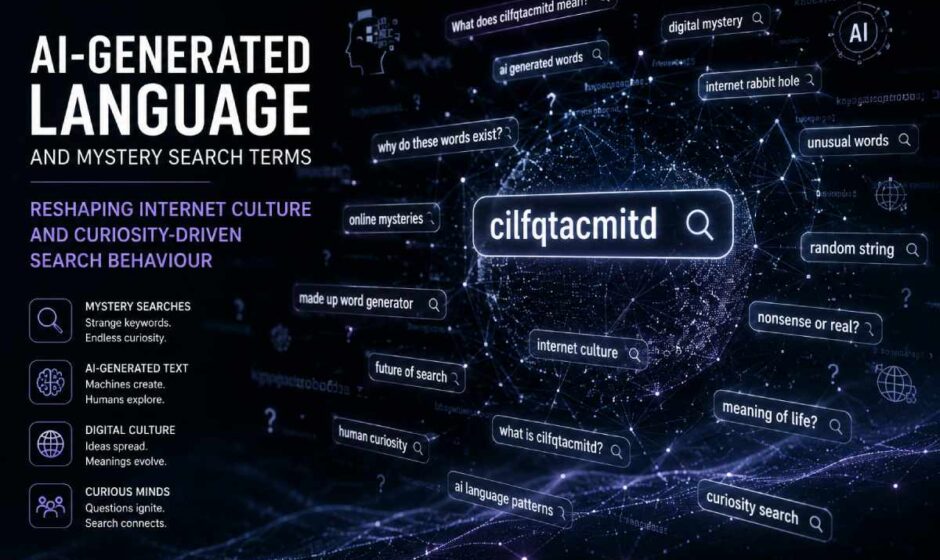
Through content generated by artificial intelligence, algorithmic systems, games, and automated responses, the Internet continually produces bizarre phrases, made-up words, and mysterious search queries. Some of these spread widely because people become intrigued to learn whether they are really meaningful or have some digital significance.
Cilfqtacmitd–is one of the examples. At present, it appears to be an unintelligible (possibly generated by AI) string of text related to unusual online search activity and algorithmically generated characters, rather than a commonly known word, product, or brand. This article will discuss what it could mean, why strange-looking words like this one may be found online,e and what these types of mysterious terms (like Cilfqtacmitd) tell us about the changing connections between AI, internet culture,e and search behavior in Malaysia.
What Is Cilfqtacmitd Malaysia?
What I will be truthful and blunt enough to admit is that, at this present moment in time, there is no publicly recognized definition of “cilfqtacmitd” yet. None of the universally verified dictionary products, brand registration schemes, or known digital communities are showing for this word yet.
What the term does have in common is a visual similarity to strings of text generated by AI, composed of consonants and vowels, that do not form a doable word in any of the five most common languages, yet follow the logic of a computer or random text generator, or, failing that, appear to do so. That it appears in Malaysian search terms indicates either Malaysian origin or that Malaysian searchers were trying to understand a term they encountered on the Internet.
This openness is necessary. To treat this undefined term as if it has a fully specified, defined sense would be a deception and of no use. What is much more valuable is understanding the broader signal it represents.
Why Strange Search Terms Appear Online
The Internet has always generated odd language, but the rate of occurrence and release of odd search terms has considerably increased in the AI era, due to the following factors:
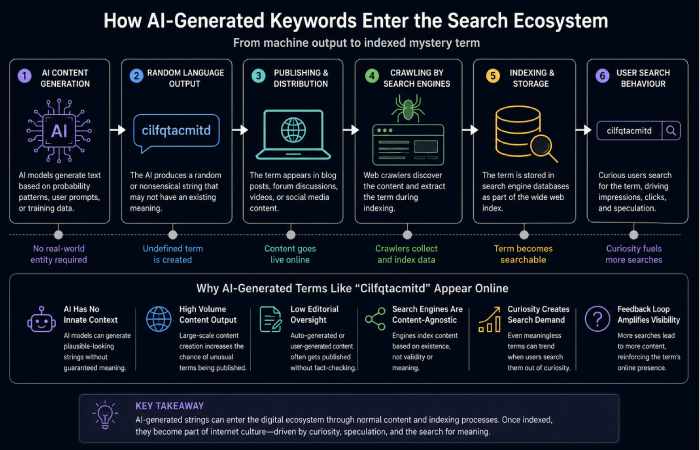
A significant portion of the body of published online text is now generated by artificial intelligence. Some tools that generate large quantities of content create puns, combinations of words, phrases, and hybrid forks that have no real-world connotation but are nonetheless published, indexed, and searched for.
Randomized keyword systems (for SEO testing, content automation, and programmatic advertising) sometimes generate strings that are entered into search databases without any human author explicitly writing them.
Memes and internet culture have a historical penchant for intentionally coining meaningless words to establish a sense of community. Words without any outside meaning can take on great meaning within a certain group.
Some others had to do with what search engines do when they get strange queries. People who wonder what search engines do with gibberish expect to type in fabricated words.
All of these routes can lend a truly amorphous term an actual online presence, and once people‘s curiosity gets piqued, the searches will lead people’s
Could Cilfqtacmitd Be AI-Generated?
This is the central question, and the phrase‘s construction seems to validate it being phrase’s possibility.
AI language models can generate text by predicting what a presumably good set of characters or tokens might be statistically likely to come next. When they are prompted in exotic ways, using limited output modes or low-temperature modes, they can produce strings that are outside the domain of any language. They look like words, they behave as words in a sentence context, but they mean nothing:
” Cilfqtacmitd” adheres to various norms for this”sort of generation”tion – strange consonant clusters, a suitable size for most words, and no obvious base in English, Malay, or any other common language. On the other hand, it could just as easily have been created by a bonobo randomly producing letters, a filler for a missing chunk in a text template, or a contrived term added to play with search engine results.
None of the above possibilities can be verified without authenticated origin data, but all are detectable realities in today‘s digital domain.
How AI Is Changing Internet today’s usage
Synthetic Keywords and Random Phrases
Unlike human intelligence, relevant AI has no understanding of meaning. It understands only associations and patterns. When these fail either through exposure to anomalies, ‘training data’ that is the wrong shape, or for other reasons, for instance greedy indexing bots and hijacked query strings, the output can be string sequences that ‘sound’ like language but which have no understandable learning.
Search Engines and Unknown Terms
When faced with a totally unfamiliar term, a search engine isn’t limited to just giving up. It makes a prediction by examining the query’s context, identifying similar structures in the rest of the query, and inferring the user’s need based on behavior patterns. A query such as “can I use a lot of cilfqtacmitd” gives contextual clues even if the “cilfqtacmit” part is unknown, and search engines use those clues to give the best available response.
Internet Curiosity and Viral Search Behavior
Curiosity is driving traffic. When we see a strange term in a comment, in a gaming UI, or in some nonsense text generated by AI, clicking the Google search button is very close to a reflex. This search activity can be quantified, and if it is expressed enough times, the search footprint of the undefined term becomes valuable to content creators.
Gaming, Forums,s and Anonymous Culture
There is dialect within online groups. Such a seemingly random string of characters might be used as a cipher phrase in a community, as a deliberately obscure reference to an inside joke, or as a token identifying an ingroup while remaining unintelligible to outsiders. ‘Cilfqtacmitd’ could potentially fulfill any of the functions in any community that did not keep its connotations public.
Why People Search for Unexplained Keywords
Curiosity, one of the most reliable and consistent habits of online behavior, also interacts with those other forces in a way that makes search engines unmistakably compelling. The anxiety about what you might not know, the need to be part of a cultural movement, and the awkwardness of something foreign all drive people to search engines.
Searching for things such as “cilfqtacmitd”, people care less about the definition and more about being validated either in discovering a real meaning that had eluded them, or in finding others equally confused. Both are nourishing to the searcher‘s psyche, and search engines have to show how to display content that is both controversial and transparent.
Could AI Accidentally Come Up With Viral Internet Terms?
More and more, the answer is a yes. Content automation publishing at scale across hundreds of thousands of blogs, social publishing sites, and aggregator sites can inadvertently introduce an unintended word or phrase into the index. The index then allows the curiosity and the traffic to find that term. The more traffic, the more content writers create for it. A feedback loop begins, and that accidental term suddenly has an active online discussion community.
This has happened. It happened before with auto-generated article titles, a series of randomly generated product names, and content placeholders produced by a computer and published before being checked by human editors. The sheer volume of content being produced today, here, increases the chances of such an accident happening again.
Cilfqtacmitd Malaysia vs Traditional Internet Slang
| Feature | AI-Generated Mystery Terms | Traditional Internet Slang |
| Meaning clarity | Often unclear | Usually understood within the community |
| Human origin | Sometimes absent | Community-created |
| Viral curiosity | High | Moderate |
| Algorithm influence | Strong | Lower |
| Longevity | Uncertain | Often durable within the community |
| Geographic spread | Instant via indexing can be | Typically spreads through usage |
How Search Engines Handle Unknown Keywords
Search engines are quite sophisticated in deducing meaning even when the input includes a new or unknown term:
Semantic prediction also considers the whole query pattern. ‘Can I use a lot of’ is a recognizable question pattern, indicating the user is inquiring about quantity, appropriateness, or permission (with an unspecified object).
Entity detection compares an unknown term against known entities based on its form and context, then matches it. When no match is found, the search engine recalls that no entity was found and returns the answer to the question.
Search pattern analysis begins by examining the behavioral responses of other users to a specific search term. It uses this information to refine the relevance of results for that search name.
That is, content put together neatly, trying to tell the truth about a floated term with contextual weight, can rank for that term because it better captures the real intent of the query than any page trying to sound like it has the right answer.
The Growth of AI-Generated Content in Malaysia
The digital ecosystem in Malaysia has been growing rapidly in recent times, thanks to high internet penetration, strong social media adoption, and an ever-growing creator economy. With this growth has come rising awareness of AI-generated content, including both homegrown and imported pieces.
Malaysian users are exposed to AI-generated text across news aggregators, social media, chat applications, and content aggregation services. As the deployment of AI writing technologies becomes cheaper and easier, a larger proportion of native content still has traces of machine text. Malaysia is, therefore, an ideal place for examining AI-generated language lift, mystery words, and the search behavior that inhabits it.
Is Cilfqtacmitd Likely to Catch on Truly Internet-Wide?
There is a well-established history to the journey from an undefined term to an established internet phenomenon. It is usually arrived at through some mixture of repetition, community adoption, and algorithmic reinforcement.
“Cilfqtacmitd” has the kind of physical make-up that, on rare occasions, makes adoption of this sort a possibility- rare enough to be memorable, short enough to be shared, vague enough to allow ponderings. If, in turn, it takes this road, which depends, like anything else, on the community willing to embrace it and hold its meaning.
Does Cilfqtacmitd Pose Any Security Risks?
It is important to clarify the point. From current known data, there is no confirmed link between ‘cilfqtacmitd’ and the following:
- Malware or malicious software’
- Phishing schemes or scam activity
- Known cybersecurity threats
- Harmful automated systems
Users who encounter this term in unexpected places — such as unsolicited messages, unfamiliar links, or suspicious emails — should apply standard digital safety practices regardless of the specific term involved. The presence of unusual or undefined language in a message is itself sometimes a signal of automated or suspicious origin.
Why AI-Generated Language Is Becoming More Common
The volume of AI-generated text on the Internet is growing faster than most users realize. Large language models, content automation platforms, SEO tools, and chatbot systems collectively produce billions of words of published content every day. Much of this content is useful, accurate,e and well-structured. Some of it is not.
The by-products of large-scale AI publishing include synthetic vocabulary, grammatically plausible but semantically empty sentences, and occasionally invented terms that enter the digital ecosystem without editorial oversight. Understanding this process does not require deep technical knowledge — it simply requires awareness that not everything published online was written with intent or meaning behind every word.
The Future of Search Behavior in the AI Era
Search behavior is changing in response to the AI landscape in ways that are only beginning to become visible. Users are increasingly encountering AI-generated content in search results themselves, not just in the queries they type. This creates a feedback loop where AI influences what gets searched, what gets published in response, and what gets recommended next.
Mystery terms like “cilfqtacmitd” are small but revealing datapoints in this shift. They show how algorithmic language generation, human curiosity, and search engine interpretation interact in real time — producing search traffic around terms that may have no intentional human automation. As AI continues to scale, this phenomenon will become more, rather than less, common, and the ability to understand and contextualize it honestly will become an increasingly valuable form of digital literacy.
Frequently Asked Questions
What is cilfqtacmitd?
“Cilfqtacmitd” currently has no verified public d”finition. It”appears to be an undefined or potentially AI-generated string with no confirmed meaning in any recognised language, product category or digital community.
Does cilfqtacmitd have a real meaning?
Not one that has been publicly documented or verified. The term may have a meaning within a specific private community or may have originated as an AI-generated or randomly constructed string.
Is cilfqtacmitd AI-generated?
Its structure is consistent with AI-generated or algorithmically constructed text, but this cannot be confirmed without verified origin information. It could also have originated from a random string generator or as a deliberately invented term.
Why do random keywords trend online?
Human curiosity is a powerful driver of search. When users encounter unfamiliar terms in the content they consume, the instinct to look them up is nearly automatic. When multiplied across enough users, this creates measurable search volume for terms that may have no established meaning.
Can AI create a new internet language?
Yes, and it increasingly does — sometimes intentionally through creative applications and sometimes accidentally through large-scale content generation that introduces undefined terms into the indexed web.
Final Thoughts on Cilfqtacmitd Malaysia
Cilfqtacmitd Malaysia reflects how AI-generated language, internet curiosity, and algorithm-driven search behavior increasingly influence digital culture, even when terms carry no officially recognized meaning or origin.
Understanding why terms like this one appear, why they attract searches, and what forces drive their brief moments of online visibility is not just an academic exercise. It is a practical form of digital literacy that helps users, content creators, and marketers navigate an internet where the boundary between human-created and machine-generated language is becoming harder to identify with confidence. In Malaysia’s growing digital landscape, literacy is becoming more relevant with every passing year.